
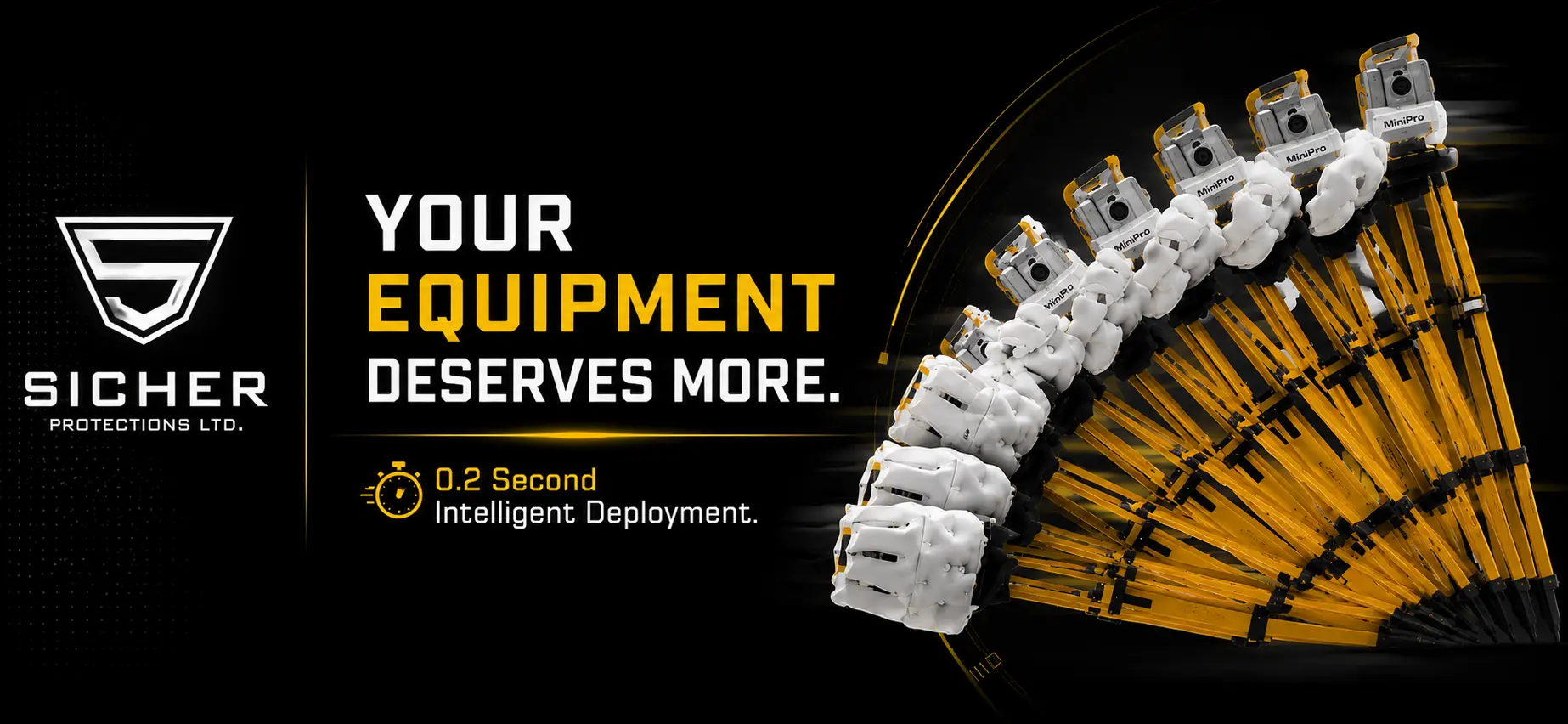
A single fall of your total station can cost you between $20,000 and $75,000 in equipment damage — plus weeks of project delays waiting on repair or replacement. For surveying professionals, geomatics teams, and construction technology providers, total station protection isn't a nice-to-have. It's the difference between a project delivered on time and a project stalled by a $50,000 accident.
This guide walks through what a total station is, why protection matters more than most surveyors realise, why traditional protective cases fall short in the field, and how modern airbag protection systems — specifically the Sicher MiniPro — have redefined what damage prevention actually means. It's built for surveyors, project managers, equipment buyers, and distribution partners looking to make an informed protection decision in 2026.
What is a total station and why does protection matter?
A total station is a precision surveying instrument that combines an electronic theodolite (angle measurement) with an electronic distance meter (EDM) to measure both horizontal and vertical angles and slope distances to a target. Modern total stations from Trimble, Leica, Topcon, Nikon, Sokkia, Spectra Precision, GeoMax, Pentax, and Faro Technologies are the backbone of construction layout, land surveying, topographic mapping, and geodetic control work.
A total station typically consists of the optical instrument itself mounted on a tribrach, which sits on a levelled tripod at a known point. Measurements are stored in an onboard controller or streamed to a paired data collector, and the resulting coordinate data feeds into everything downstream — GIS platforms, BIM models, machine-control systems, and as-built drawings.
The real cost of total station damage
Total station equipment prices in 2026 typically range from $20,000 to $75,000 per instrument — and that's just the instrument. When a fall or impact happens, the real cost picture is broader than most surveying firms track:
| Cost component | Typical range | Notes |
|---|---|---|
| Replacement instrument | $20,000 – $75,000 | New-in-box, brand and model dependent |
| Manufacturer repair (major) | $4,000 – $12,000 | If the optics and boards can be repaired at all |
| Recalibration (post-repair) | $500 – $1,500 | Manufacturer-authorised service only |
| Downtime / project delay | $1,500 – $8,000 per day | Idle crew, equipment rental gap, penalty exposure |
| Equipment insurance premium (annual) | 5–7 % of insured value | Rises after claims — often materially |
| Deductible on claim | $1,000 – $5,000 | Out of pocket even when covered |
The number that surprises most survey firms isn't the instrument replacement — it's the compounded cost of one incident: a $30,000 total station falls, insurance covers $22,000 of the $28,000 replacement (after depreciation), the firm eats $6,000 out of pocket plus the deductible, loses four project days at $3,000 per day, and sees next year's premium jump 40 %. A single accident becomes a $25,000 event by the time the paperwork settles.
Traditional protection: hard cases, foam, bumpers — and their hidden cons
Every surveyor already uses some form of protective case, protective gear, or bumper protection for their total station — the manufacturer typically ships a hard transport case with the instrument. The question isn't whether traditional protection exists. The question is whether it actually prevents damage in the moments that matter.
Here's what traditional total station protection looks like, and where each type falls short.
1. Manufacturer hard cases (Pelican-style / foam-lined)
What it does well: transport between the vehicle and the site, resistance to weather during storage, decent drop resistance when the case is closed.
What it doesn't do:
- Protects nothing when the instrument is deployed. Total stations spend 90 % of the workday out of the case, on the tripod, exposed. The case is in the truck.
- Bulky and heavy — surveyors leave the case at the vehicle to move faster across a site, at which point the case protects nothing.
- Slow to redeploy — after a scare, surveyors don't want to pack up mid-observation to case the instrument, so they don't.
- Doesn't help with the highest-frequency damage cause — tripod knock-overs and vehicle strikes on the deployed instrument.
2. Waterproof cases with impact foam
What it does well: environmental protection (rain, dust, temperature) during transport and storage.
What it doesn't do:
- Same core problem: the instrument is outside the case during use, when 80 %+ of damage actually happens.
- Adds weight to the load-out without adding protection during work.
- Foam degrades over time, especially with UV and temperature cycling in field vehicles.
3. Bumper protection / rubberised sleeves
What it does well: protects against minor knocks and scrapes on the housing during handling.
What it doesn't do:
- Doesn't absorb fall energy — a rubberised bumper does not save a total station from a 1.5-metre tripod fall onto concrete.
- Leaves the optical head unprotected at exactly the angle it typically strikes the ground first.
- Sometimes voids manufacturer warranty because it obscures ports and vents.
4. Shock-resistant tripod feet and stability accessories
What it does well: reduces the frequency of tripod knock-overs on unstable surfaces.
What it doesn't do:
- Does nothing when the tripod goes down for reasons other than surface instability — most commonly, someone or something bumping into it.
- Doesn't help with vehicle strikes on job sites — a real and frequent cause of instrument loss.
- Doesn't help with wind gusts on elevated or exposed setups.
The core problem with all traditional protection
That is the specific problem MiniPro was designed to solve.
Modern airbag protection: how smart sensor technology changes the game
The Sicher MiniPro is the world's first automatic airbag protection system for tripod-mounted surveying instruments. Developed by engineers Qubti Elias and Khoury Elias, MiniPro takes the same principle that has saved millions of lives in vehicle airbags — detect impact, deploy protection in milliseconds — and applies it to the $20,000–$75,000 instrument sitting exposed on your tripod.
Here's how the smart-sensor technology works:
Continuous monitoring
MiniPro mounts directly to the tripod, below the instrument. Once locked in place with the tripod locking system, its onboard sensor array continuously monitors the tripod's orientation, movement, and acceleration profile. It runs silently in the background throughout the workday.
Fall prediction
The MiniPro sensor system doesn't wait for the instrument to hit the ground. Its smart prediction algorithm recognises the specific acceleration and orientation signatures that precede a fall — a tilt beyond recoverable angle, a rapid acceleration in an unusual direction, an impact on the tripod leg — and identifies a genuine fall event in milliseconds.
Instant airbag deployment
The moment a fall event is confirmed, the MiniPro airbag deploys around the instrument, creating a 360-degree cushioning envelope that absorbs the impact energy before the total station strikes the ground. The instrument lands cushioned, not exposed.
Post-deployment reset
After deployment, the MiniPro is restored to service using the official MiniPro Airbag Recycling Kit ($150 USD), typically in the field within minutes. The unit returns to protective service on the same tripod, same day.
MiniPro vs traditional protection: side-by-side comparison
| Factor | Traditional (hard case / bumper) | Sicher MiniPro |
|---|---|---|
| Protects during workday use | ✕ No — instrument is out of the case | ✓ Yes — mounted permanently on the tripod |
| Absorbs fall energy on impact | ⚠ Partially — only during transport | ✓ Yes — airbag deploys before impact |
| Automatic response to a fall | ✕ None | ✓ Yes — smart sensor detects, deploys in ms |
| Weight added to load-out | 5–15 kg (case) | 1.1 kg (MiniPro unit) |
| Setup time per deployment | Case unpacking + tripod setup | Included in normal tripod setup |
| Operates in extreme temperatures | Depends on case material | −40 °C to +65 °C guaranteed |
| Waterproof / dustproof | Case is; instrument during work isn't | ✓ Yes — active protection is IP-rated |
| 360-degree impact coverage | Only 6-sided when packed | ✓ 360-degree deployment envelope |
| Compatible with major brands | Case-specific to model | ✓ Universal: Trimble, Leica, Topcon, Nikon, Sokkia, Spectra Precision, GeoMax, Pentax, Faro |
| Reusable after a protection event | N/A (case doesn't 'deploy') | ✓ Yes — with the $150 Recycling Kit |
| Up-front cost | $400–$1,500 (premium case) | $999 USD (MiniPro unit) |
| Cost per prevented incident | $0 (doesn't prevent) — full loss borne | 1 % of a single $30k instrument replacement |
| Insurance impact | Doesn't change premiums | Documented protection can support premium reviews |
Stop insuring the loss. Prevent it.
MiniPro is $999 — around 1 % of what a single destroyed total station costs you once downtime and premiums settle.
Real-world validation: drop tests and industry endorsements
Any protection product's real credibility comes from independent validation, not manufacturer claims. MiniPro's field performance has been certified and endorsed by three separate industry partners across two continents:
Falcon Geomatics LLC (UAE) — official live-test certification
Falcon Geomatics LLC, a leading provider of surveying and geomatics solutions in the UAE, conducted a live test of the MiniPro protection system for total stations at their Ras Al Khor facility. The test demonstrated the product's effectiveness and reliability in safeguarding equipment under real working conditions, and Falcon officially certified the result. This certification is displayed on the MiniPro product page.
Rise Geo Control Systems Trading LLC (UAE) — professional endorsement
Rise Geo Control Systems Trading LLC issued a formal recommendation of the MiniPro Protection Cover, specifically citing its safety and reliability in protecting total stations and 3D scanners. The endorsement is published on the MiniPro product page with the recommendation letter attached.
Geocentrum / Protection Airbag Europe — European market recommendation
Geocentrum / Protection Airbag Europe (Netherlands) provided a formal recommendation for the MiniPro airbag system after real-world field use with total stations and laser scanning equipment. The Geocentrum recommendation letter is published on the MiniPro product page and marks the entry point for MiniPro's European distribution footprint.
Institutional recognition
Sicher Protections Ltd is recognised by the Society of Engineers in the United Arab Emirates for its contribution to innovation and excellence in engineering, with participation in the 3rd edition of the Excellence and Creative Engineering Award. This recognition affirms the engineering rigour behind the MiniPro system and the wider Sicher Protections product line (about our company).
Compatibility: which total stations does MiniPro protect?
MiniPro is designed for universal compatibility with tripod-mounted surveying instruments — not model-specific. Because it mounts to the tripod itself rather than the instrument housing, MiniPro protects any total station, 3D scanner, GNSS receiver, or specialised camera system that mounts on a standard survey tripod.
Confirmed compatibility across the major surveying brands used in 2026:
- Trimble total station — full compatibility across the S-Series (S5, S7, S9), SX-series scanners, and the Ri robotic range
- Leica total station — full compatibility across the TS/TM range (TS16, TS60, MS60 MultiStation) and the RTC360 / BLK-series scanners
- Topcon total station — full compatibility across the GT / MS / DS series
- Nikon total station — full compatibility across the Nivo, XS/XF, and NPL series
- Sokkia total station — full compatibility across the CX/DX and iX robotic series
- Spectra Precision — full compatibility across the FOCUS and RANGER lines
- GeoMax — full compatibility across the Zoom range
- Pentax — full compatibility across the W-800 / W-1500 / R-1500 series
- Faro Technologies — compatibility with Faro Focus and Orbis scanner ranges (mounted on standard tripods)
For non-standard tripod interfaces, larger instruments, or specialised sensor systems, Sicher Protections offers the TopPro system as a larger-format alternative, and works with dealers to custom-fit protection for specific configurations. Speak to your regional dealer via the dealer network page.
How much does total station protection cost?
The Sicher MiniPro is priced at $999 USD, direct from Sicher Protections or through the global authorised dealer network. The official Airbag Recycling Kit, used to restore the MiniPro to service after airbag deployment, is priced at $150 USD.
The ROI framing
- MiniPro price: $999
- Cost of a single prevented mid-range total station loss: ~$25,000 (instrument replacement + deductible + downtime + premium impact)
- Break-even: MiniPro pays for itself the first time it prevents damage — and it prevents damage on every fall event it detects, not just once. It's not consumable protection.
- Recycling kit cost per deployment: $150 — a rounding error against a prevented incident.
Compare that to traditional protection alone: a premium hard case runs $400–$1,500, protects the instrument only during transport, and does zero to prevent the falls that account for the majority of survey-equipment insurance claims. The traditional protection budget doesn't lower risk during the workday. MiniPro does.
Where to buy
- Direct from Sicher Protections — MiniPro product page, ships internationally, PayPal accepted
- Through authorised regional dealers — 16+ countries covered, find your nearest dealer
- Become a Sicher Protections dealer — dealer application for surveying and geomatics distributors
How to choose the right protection for your workflow
The right total station protection setup in 2026 is a layered approach — the manufacturer's hard case for transport and storage, plus active airbag protection during use. Here's the decision framework we use with surveying firms and geomatics distributors:
If any of these apply to your workflow, MiniPro pays for itself very quickly:
- Your surveyors work near active vehicle traffic (roadway surveys, construction sites, industrial yards)
- You've lost or damaged an instrument in the last 24 months
- Your equipment insurance premium is rising or your excess is climbing
- Your fleet contains high-value instruments — $30,000+ per unit is common today
- You operate in high-wind or exposed environments (bridges, rooftops, coastal, mountain)
- You have distributors or subcontracted crews using the equipment (higher variability of handling care)
Ready to protect your total station?
Sicher Protections Ltd. is a UAE-founded protection systems engineering company, recognised by the Society of Engineers in the United Arab Emirates for innovation in equipment protection. Our flagship MiniPro airbag system is the world's first automatic airbag protection for tripod-mounted surveying instruments, in service with distributors across Europe, the Middle East, Asia, and Africa.
Get MiniPro protection today
$999 USD · ships internationally · 16+ country dealer network · +971 4 353 0636
For adjacent protection needs (worker safety, motorcycle riders, military tripod-mounted sensor systems), see our VestPro and TopPro product lines.